Fabrics & Upholstery
Bed headboards: sizing, styles and upholstery
How to size a queen or king bed headboard, choose between wall-mounted and frame-mounted designs, and pick fabrics that age well.
A bed headboard does three jobs. It gives you something comfortable to lean against when reading or having breakfast in bed, it protects the wall from pillows and hair oils, and it anchors the bed as the focal point of the room. A good headboard is sized to the room as much as to the mattress, uses a fabric or material that ages gracefully, and is fixed securely enough that it never knocks or creaks.
This guide covers headboard sizes for queen and king beds, height and proportion, the main construction types, upholstery choices, and the details that matter in Singapore’s warm, humid bedrooms.
Bed headboard sizes for queen and king beds
Mattress sizes vary between countries and makers. In Singapore, queen mattresses are commonly around 150 to 153 cm wide and king mattresses around 180 to 183 cm wide, with lengths around 190 cm. Always measure your actual mattress and bed frame before ordering.
| Bed | Typical mattress width | Suggested headboard width |
|---|---|---|
| Single or super single | About 90 to 107 cm | Mattress width plus 5 to 10 cm |
| Queen | About 150 to 153 cm | About 160 to 170 cm, or match the frame |
| King | About 180 to 183 cm | About 190 to 200 cm, or match the frame |
| Wall-to-wall panel | Any | Full wall width, or bed plus bedside tables |
Queen bed headboard
A queen bed headboard should be at least as wide as the bed frame, and usually a few centimetres wider on each side so the frame does not show beyond it. In smaller condo bedrooms, a queen headboard that stops neatly at the frame keeps space for bedside tables.
King bed headboard and king size bed headboard proportions
A king bed headboard can look squat if it is wide but low. Increasing the height slightly, or extending the headboard to include the bedside tables, helps it hold the wall. In larger master bedrooms in landed homes, a king size bed headboard extended into a full-width upholstered panel gives the room a hotel-like calm.
Height and proportion
- Standard. Headboards around 100 to 130 cm from the floor suit most rooms, sitting comfortably above stacked pillows.
- Tall. Headboards of 140 cm or more add drama in rooms with higher ceilings, and work well with wall lights mounted on or above them.
- Low. Under 100 cm suits beds under windows or a low, Japandi-inspired room, but offers less back support.
To check comfort, sit up in bed with your pillows and have someone measure from the mattress top to the point between your shoulder blades and the back of your head. The padded zone of the headboard should cover that range.
Note window sills, air-conditioning units, switches and sockets on the bed wall. Bedside switches and reading lights are much neater when planned into the headboard from the start.
Wall-mounted or bed-mounted
| Type | Advantages | Considerations |
|---|---|---|
| Bed-mounted (bolted to the frame) | Moves with the bed; no wall drilling; suits rentals | Can knock the wall; must match the frame’s fixing points |
| Wall-mounted (cleat or rail) | Firm and silent; height can be set freely; bed can be changed later | Needs a sound wall and accurate fixing; check condo by-laws for works |
| Integrated into the bed | Clean, unified look | Replacing the headboard means replacing the bed |
| Full-wall panelling | Strong architectural effect; can include lights and shelves | Highest cost; joinery and upholstery coordinated on site |
A wall-mounted headboard is usually hung on a timber or aluminium French cleat. Drywall partitions need fixings into studs or reinforcement, which is easiest to plan during a renovation.
Upholstery choices
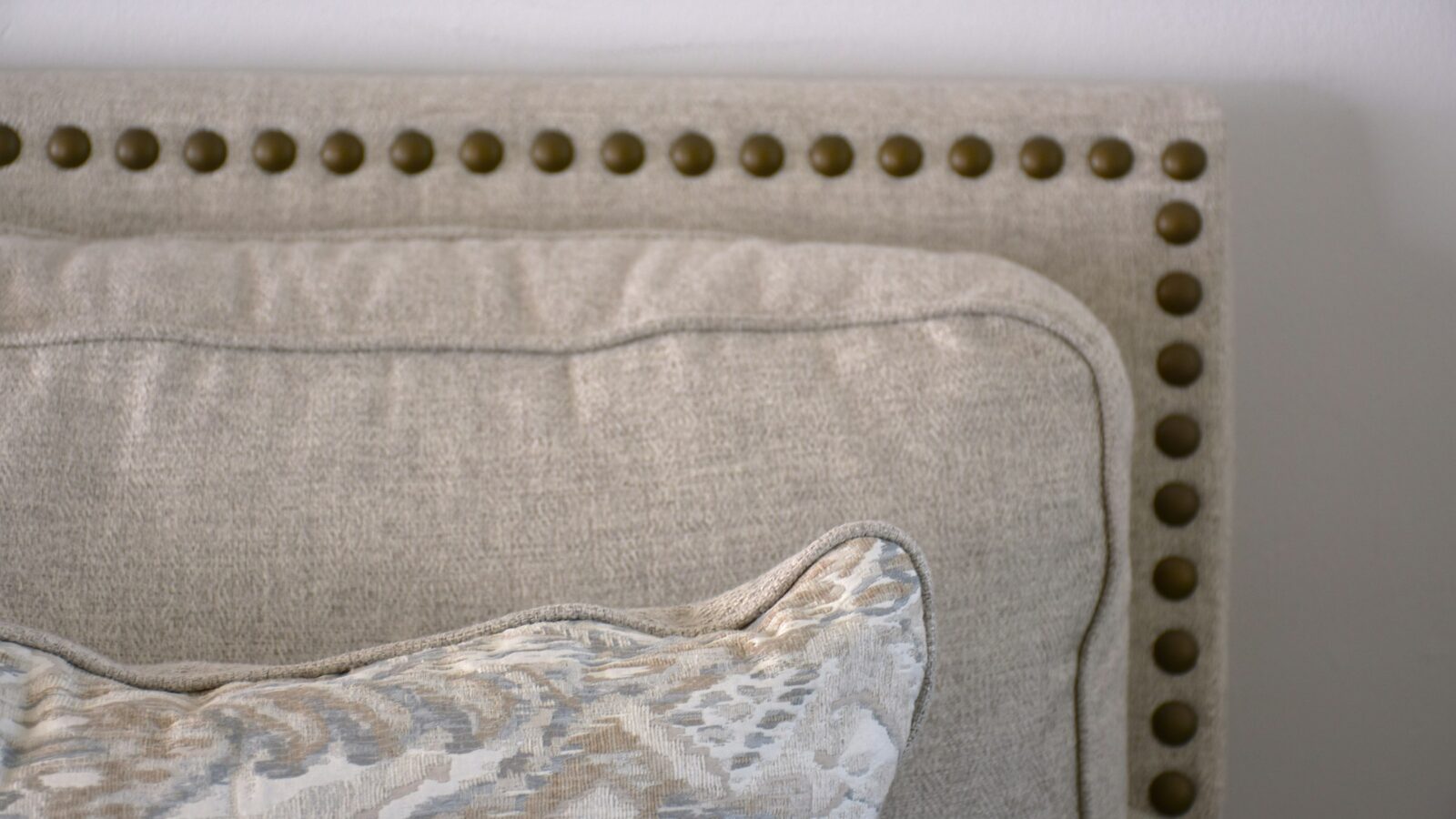
An upholstered bed headboard is touched daily by hair, skin and pillows, so the fabric needs to resist marking and be easy to clean.
- Velvet. Rich, soft and quiet. A cotton or performance velvet with a short, dense pile resists crushing. See our page on velvet upholstery.
- Linen and linen blends. Relaxed and breathable, with a natural slub. Pure linen creases and marks more easily; blends behave better. Our linen fabric page covers the trade-offs.
- Boucle. Textured and forgiving of small marks, though loops can snag on jewellery.
- Performance fabrics. Woven synthetics or blends treated to resist stains. Practical in children’s rooms and guest rooms.
- Leather. Durable and easy to wipe, but warm against skin in a non-air-conditioned room.
Hair oils and products slowly darken the area where heads rest. Mid-tones and textured weaves disguise this far better than pale, flat fabrics. A removable, zipped or Velcro-fixed cover makes cleaning possible without re-upholstering the whole piece.
Styles that age well
- Plain panel with a fine piped edge, the quietest option.
- Vertical channels, which add height and rhythm.
- Soft buttoning or shallow tufting, which adds texture without fussiness.
- Timber frame with an upholstered inset, which pairs joinery with fabric.
- Curved or wing-shaped headboards, which give a sense of enclosure in larger rooms.
Deep diamond tufting and very tall, ornate profiles date faster. For more on composing the room around the bed, see our sibling guide to bedroom design.
Lighting, power and other details
A headboard is a natural place to hide the small services a bedroom needs. Planning them early avoids trailing cables and patched walls later.
- Reading lights. Wall lights or adjustable arms fixed to the headboard or just above it. Position them so the beam falls on the page, not in your partner’s eyes; a warm colour temperature suits bedrooms.
- Switches. Two-way switches on each side to control the main light, so nobody has to get up to turn it off.
- Charging points. Sockets or USB outlets set into the side of the headboard or a nearby bedside panel.
- Access panels. If wiring runs behind an upholstered panel, ask for a removable section so an electrician can reach it later.
In hotel rooms, the headboard wall usually carries all of these, plus acoustic padding against the neighbouring room. The same thinking works at home, especially in bedrooms that share a wall with a living area or a child’s room.
Humidity and the bed wall
Singapore’s annual mean relative humidity is in the low 80s per cent. A large upholstered headboard set tight against an external wall can trap moist air, particularly if the room is closed up without air-conditioning during the day.
- Leave a small gap of a centimetre or two behind wall-mounted panels so air can circulate.
- Use moisture-resistant boards and foam inside the headboard.
- Check any external wall for damp before installation.
- Vacuum the fabric with an upholstery brush every week or two to remove dust and skin flakes.
Frequently asked questions
How wide should a queen bed headboard be?
At least as wide as the bed frame, often around 160 to 170 cm for a Singapore queen mattress of about 150 to 153 cm. Measure your frame before ordering.
What is the best height for a king size bed headboard?
Around 120 to 140 cm from the floor suits most rooms and keeps proportions balanced with the wider bed. Taller is fine in rooms with high ceilings.
Which fabric is easiest to keep clean on a headboard?
Performance fabrics and tightly woven velvets in mid-tones are easiest. Removable covers make deep cleaning simpler.
Can I add a headboard to my existing bed?
Yes. Either bolt it to the frame if fixing points allow, or mount it on the wall behind the bed, which also stops it knocking.
The headboard is the piece you see last at night and first in the morning. If you are planning a bedroom and would like help with proportions, fabric and fixing, we would be glad to arrange a consultation. More on fabrics is on our fabrics and upholstery page.