Carpets & Rugs
Oval dining room rugs: sizing, materials and when to choose one
When an oval rug suits a dining room, how big it should be, and which fibres and edges survive daily meals.
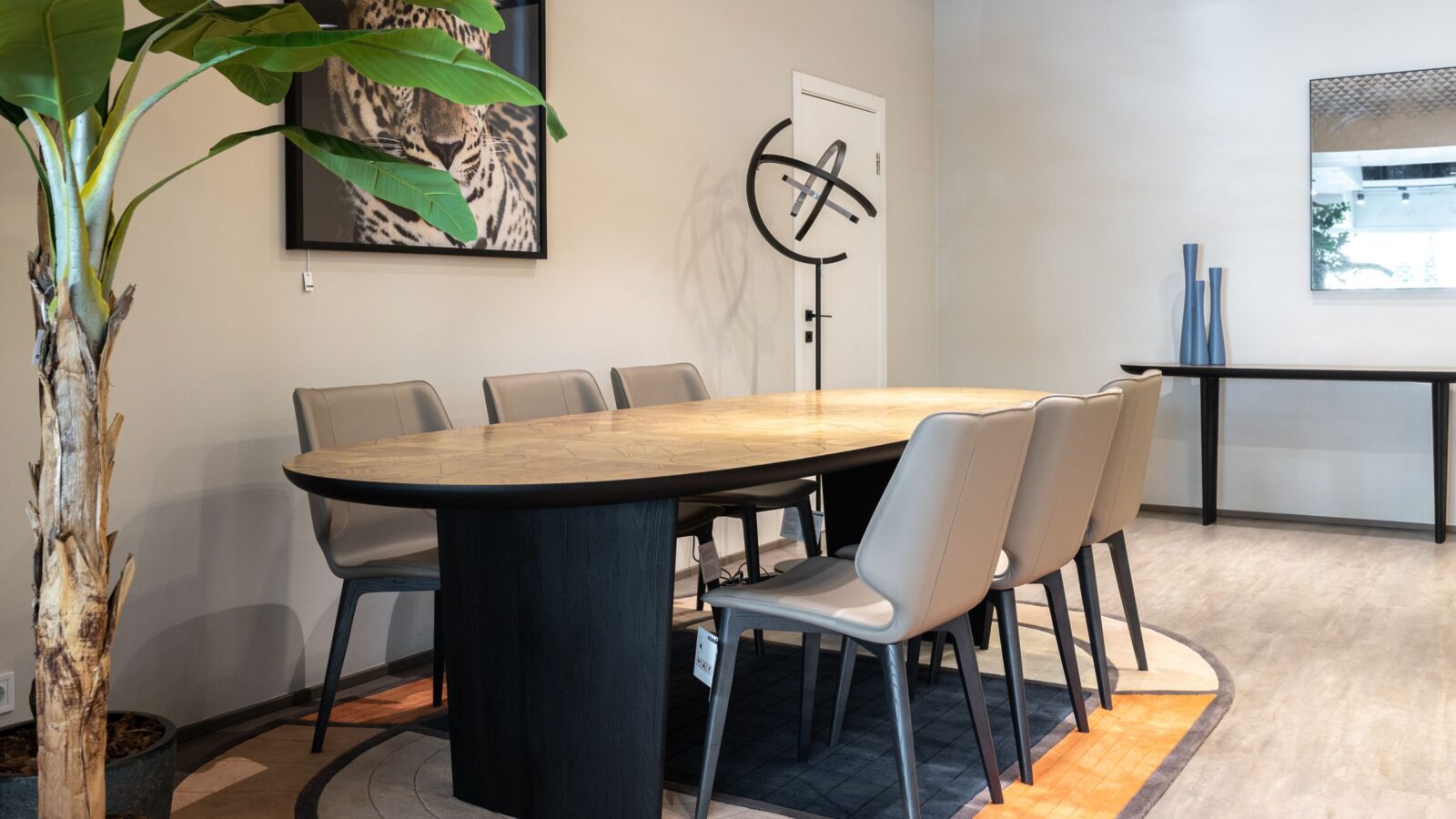
Oval dining room rugs are the natural partner for an oval or racetrack table. The curved outline echoes the table, softens a room full of chair legs and straight lines, and leaves the corners of the floor clear, which helps in tight dining areas. The rule that matters most is size: the rug must be large enough for every chair to stay on it when pulled out, which usually means 60 to 75 cm of rug beyond the table edge on all sides.
This guide covers when an oval rug is the right choice, how to size it, which constructions cope with dining-room spills, and how the choice plays out in Singapore homes with open-plan living and dining spaces.
When an oval rug makes sense
An oval rug is not automatically right for every oval table, and it can work in places you might not expect.
- Oval or racetrack tables. The obvious pairing. The rug mirrors the table and the composition feels calm and complete.
- Round tables in long rooms. A long oval under a round table, with a sideboard or bench at one end, can fill a narrow dining room better than a round rug.
- Open-plan spaces. In a condo where the dining area is one end of a long living room, a curved rug marks out the zone without drawing a hard rectangle on the floor.
- Rooms with curved architecture. A bay window, an arched opening or a curved wall gives the oval a reason to be there.
A rectangular table usually wants a rectangular rug. An oval under a rectangular table leaves the corner chairs half off the rug, which looks awkward and makes them rock.
Sizing oval dining room rugs
Measure the table, then add the chair zone. The chair zone is the distance a chair moves back when someone stands up, usually 60 to 75 cm. Double it for the two ends and the two sides.
| Table size (approx.) | Seats | Minimum rug size |
|---|---|---|
| 150 x 90 cm | 4 to 6 | about 270 x 210 cm |
| 180 x 100 cm | 6 | about 300 x 230 cm |
| 220 x 110 cm | 8 | about 350 x 250 cm |
| 260 x 120 cm | 8 to 10 | about 400 x 270 cm |
These figures assume a 60 cm chair zone. Larger dining chairs and armchairs need more. Check also that the rug leaves at least 20 to 30 cm of floor between its edge and the walls or sideboard, so it reads as a rug rather than a carpet that did not fit. Stock oval rugs come in a limited range of sizes, so a custom rug is often the only way to get both proportion and clearance right. Our guide to the rug under a dining table covers rectangular and round tables too.
Choosing a dining room rug that survives meals
Any dining room rug has to deal with food, drink and chairs dragging back and forth. Construction matters as much as colour.
- Low, dense pile or flatweave. Chairs slide more easily and crumbs sit on the surface where they can be vacuumed. Avoid shag and deep pile under a table.
- Wool. Naturally soil-resistant and resilient. A tight wool pile handles chair traffic and responds well to spot cleaning.
- Solution-dyed synthetics. Very resistant to staining and fading, a sensible choice for families with young children.
- Avoid viscose and silk. They mark with water and do not recover from crushing.
- Pattern helps. A tonal pattern or a mottled weave forgives spills far better than a pale solid.
An oval rug needs a neatly finished edge. Bound or serged edges on a curve should sit flat, without ripples. Ask to see an edge sample before ordering a made-to-measure piece.
Colour also deserves a test. Dining rooms are often lit by a warm pendant at night and by daylight at lunch, and a rug can look quite different under each. Ask for a sample large enough to judge, at least the size of a dinner plate, and look at it on the floor where the rug will sit, at both times of day. Check it next to the table finish and the chair upholstery too, since those three surfaces are seen together whenever you sit down.
Oval rug versus round and rectangular
| Shape | Best with | Advantages | Limitations |
|---|---|---|---|
| Oval | Oval and racetrack tables | Soft outline, clears corners, mirrors the table | Fewer stock sizes; harder to fit under rectangular tables |
| Round | Round tables in square rooms | Compact, balanced | Too short for long tables |
| Rectangular | Rectangular tables | Widest choice, easy to size | Can feel rigid in a room with curves |
If you are still choosing the table, consider the rug and table together. An oval table seats more people for its footprint than a round one, and its curved ends make circulation easier in a narrow dining zone. Our dining room design ideas discuss tables and layouts in more depth.
Styling the oval rug and room carpet together
An oval rug is a strong shape, so keep the rest of the composition calm. A rug in a single tone with a subtle border suits most contemporary rooms. A traditional oval with a central medallion works in a formal dining room, especially under a chandelier centred on the table. If the dining area sits next to a living room with its own rug or room carpet, keep the two related in colour or texture but not identical, so each zone has its own identity.
Light the table, not the rug. A pendant or linear light centred over the table pulls the eye to the right place and makes the rug read as a frame around the setting.
Care and practicalities in Singapore
Dining rugs are spot-cleaned more often than any other rug in the house. Keep a white cloth and plain water to hand, blot immediately and work from the outside of a stain inwards. Vacuum after meals with children, and rotate the rug twice a year so the chair paths wear evenly.
Humidity matters here too. The Meteorological Service Singapore cites a mean annual relative humidity of around 82%, and a damp spill trapped under a rug and pad can lead to odour or mould. Lift a corner after a large spill and let both the rug and floor dry. A felt or natural rubber pad keeps the rug in place and stops chairs from pushing it out of alignment.
Related reading: Oval braided rugs and Half circle rugs.
Frequently asked questions
How big should an oval rug be under a dining table?
Add 60 to 75 cm to every side of the table, so chairs stay on the rug when pulled out. For a 180 x 100 cm table, that means a rug of roughly 300 x 230 cm.
Can I use an oval rug under a rectangular table?
It is possible with a very large oval, but corner chairs often end up half on and half off the rug. A rectangular rug is usually the better choice.
What is the best material for a dining room rug?
A low, dense wool pile or a tight flatweave. Solution-dyed synthetic rugs are a practical alternative where spills are frequent.
Do oval rugs need a rug pad?
Yes. A pad stops the rug creeping as chairs move, protects the floor and keeps the curved edge lying flat.
Getting a dining rug right is a question of proportion, edge detail and fibre. If you would like help sizing a made-to-measure oval rug or planning the dining room around it, arrange a consultation with our team. You can also browse more options on our carpets and rugs page.


